Why Spreadsheets Break Property Operations
The structural problem behind messy portfolio data and how modern property teams fix it
The Spreadsheet That Slowly Took Over Everything
Every property operation starts as a spreadsheet.
At the beginning, it’s harmless. One file. A few columns. Some rows. Maybe a couple of dropdowns if someone’s feeling ambitious. It works, it’s quick, and everyone understands it.
Then reality happens.
You add another property. Another landlord. Another tenant. Another maintenance workflow. Another compliance deadline. Suddenly the spreadsheet isn’t just tracking information — it’s running your entire portfolio.
And that’s when the cracks begin.
Not because spreadsheets are bad tools. They’re brilliant tools. But they were never designed to be property management systems.
The real problem isn’t the data.
The real problem is structure.
The Hidden Cost of Spreadsheet Thinking
Most property teams don’t notice when their spreadsheet becomes a system. It happens gradually. Columns get added. Tabs multiply. Naming conventions drift. People copy and paste old rows as templates. Someone creates a second version of the master tracker because they “didn’t want to break anything.”
By the time leadership realises something’s wrong, the symptoms are already visible:
- Duplicate property records across different tabs
- Conflicting data on tenant move-in dates
- Expired gas safety certificates slipping through the cracks
- Maintenance reports that don’t match reality
- Teams manually double-checking each other’s work
At that stage, the spreadsheet isn’t helping operations. It’s actively slowing them down and introducing risk.
And here’s the key insight most organisations miss:
Spreadsheet problems are rarely user errors.
They’re structure errors.
No amount of training, discipline, or process documentation can fix a system whose architecture doesn’t match the physical reality of your portfolio.
The Structural Mismatch No One Talks About
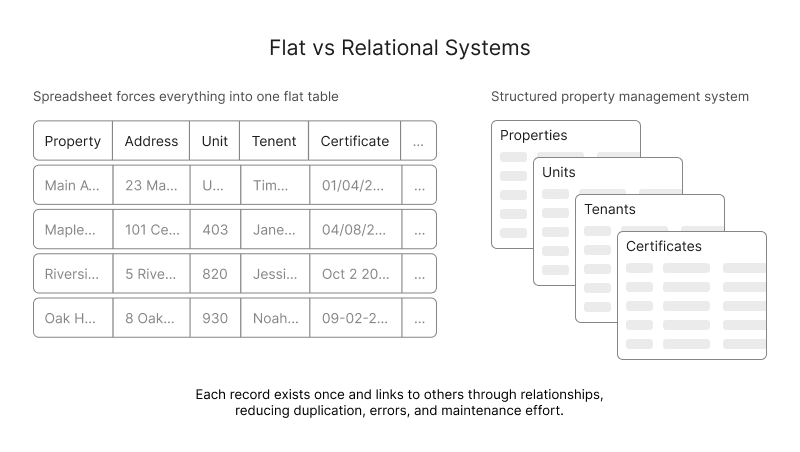
Spreadsheets store information in flat rows. But real property operations don’t exist in rows. They exist in relationships.
Consider the reality of property management. The real world looks like this:
- A portfolio contains properties
- A property contains units
- A unit contains tenancies
- Compliance belongs to specific properties or units
- Maintenance relates to both a location and a contractor
But a spreadsheet forces everything into one flat table.
That means:
| Reality of the Portfolio |
Spreadsheet Result |
| One block, 40 units |
Building address repeated 40 times |
| One unit, multiple tenants |
Unit data duplicated across rows |
| One statutory compliance check |
Expiry dates scattered across random columns |
| One leak repair |
Plumber notes buried in merged cells |
This is the core structural mismatch:
Real operations are relational.
Spreadsheets are flat.
When you try to model a relational system inside a flat grid, duplication becomes unavoidable — and duplication is the root of almost every operational data problem.
The Moment Complexity Breaks the Sheet
At a small scale, spreadsheets feel efficient. That’s why agencies and portfolio owners rely on them initially.
But complexity grows faster than people expect. Growth usually follows this pattern:
Stage 1 — Simple
- Handful of properties
- One master tab
- Everything is visible at a glance
Stage 2 — Expanding
- Multiple portfolios
- Endless scrolling and new rows
- Reliance on complex filtering
Stage 3 — Operational
- Tenancy tracking
- Compliance dates (EPCs, EICRs, Gas Safety)
- Maintenance and contractor logs
- Landlord reporting
Stage 4 — Breaking Point
- Multiple disconnected spreadsheets
- Manual syncing between Lettings and Maintenance teams
- Version control confusion
- Missing compliance deadlines
- Eroded trust in the data
At Stage 4, teams don’t have a spreadsheet anymore.
They have a fragile, improvised database — without the safeguards or automated triggers of a real one.
The Real Problem Isn’t Data. It’s Data Models.
Most property organisations think they have a data problem.
They don’t.
They have a data model problem.
A data model is simply the structure that defines:
- what things exist
- what information belongs to each thing
- how those things relate to one another
Strong systems start with a model. Weak systems start with a grid.
Here’s the difference in mindset:
| Spreadsheet Thinking |
System Thinking |
| Where should this new column go? |
What entity does this attribute belong to? |
| Where should I paste this tenant’s row? |
What unit record should this tenant connect to? |
| How do we keep this address updated? |
How do we define this address once? |
This shift — from placement to structure — is what separates scalable property management from chaotic, fragile operations.
What Real Property Systems Look Like
If you step back and examine any highly efficient property operator, you’ll notice something consistent:
Their data mirrors physical reality.
They don’t store everything jumbled together. They define distinct entities and connect them. A properly structured operational system includes tables like:
- Portfolios
- Properties (Blocks/Buildings)
- Units
- Tenancies
- Compliance Certificates
- Work Orders
Each table represents a real-world object. Each record represents a real instance. Each field represents a real attribute.
Most importantly:
Records connect to each other.
That means:
- A unit automatically links to its parent building
- A tenancy securely links to its unit
- An EPC links directly to the asset it applies to
- A maintenance request links to the exact unit, the assigned contractor, and the responsible property manager
Nothing is duplicated. Everything is connected.
Instead of just storing data, the system models the living reality of your real estate.
The Five Building Blocks of Scalable Systems
Modern operational platforms — the ones that scale cleanly — are built from five core components:
1. Tables — Real-World Objects
Not tabs. Not sheets. Core entities.
Examples: Portfolios, Properties, Units, Tenancies, Contractors.
2. Fields — Defined Attributes
Each table defines exactly what information belongs to that entity.
Examples: Postcode, Tenancy Start Date, Target Rent, Priority Level.
3. Records — Individual Instances
Each record is one real thing.
Examples: One specific flat. One specific tenant. One specific boiler repair.
4. Relationships — Connections
This is the structural backbone. Relationships define how records interact.
Examples: ‘Unit belongs to Block’, ‘Work Order assigned to Contractor’, ‘Certificate relates to Unit’.
5. Views — Perspectives
Different teams need different ways to see the same data.
Views allow Lettings to see availability, whilst Maintenance sees pending repairs — all pulling from the same underlying structure without breaking it.
Together, these five components create something spreadsheets simply cannot:
A portfolio that scales without collapsing.
The Structural Advantage
When property operations move from flat data to structured data, six major improvements happen almost immediately.
1. Compliance Becomes Foolproof
In property, bad data doesn’t just mean a missed deadline; it means a breached regulation, voided insurance, or heavy financial penalties. Structured systems can automatically track certificate expiries against specific units, making compliance proactive rather than reactive.
2. Accuracy Improves Dramatically
Because information exists in one place only, there’s no risk of conflicting versions. The elusive “single source of truth” becomes reality, not just an aspiration.
3. Scalability Becomes Effortless
Onboarding 500 new units doesn’t increase operational complexity. The underlying structure stays exactly the same. Only the volume changes.
4. Automation Becomes Possible
You cannot automate messy data. But clean, relational data enables triggers: expiring certificate alerts, automated contractor dispatch, rent review reminders, and multi-stage approvals.
5. Reporting Becomes Reliable
Landlord reports built on duplicated spreadsheet data cannot be trusted. Structured systems generate live, trustworthy reporting because every metric pulls directly from authoritative records.
6. Accountability Becomes Visible
Every record has an owner, a live status, and a full audit trail. No more ambiguity. No more guessing who last updated the spreadsheet.
Let’s compare two versions of the same property management environment.
Before — The Spreadsheet System
- One massive master file
- Repeated building addresses and landlord details
- Contractor notes embedded in text cells
- Manual syncing between Lettings and Maintenance
- Hidden dependencies
- Constant fear of accidental deletions
People spend more time maintaining the sheet than managing the properties.
After — The Structured System
- Separate but linked tables for Units, Tenants, and Work Orders
- Strict, defined fields for each data type
- Real-time compliance dashboards
- Secure access views tailored by department
- Trustworthy, automated landlord reporting
Instead of managing a spreadsheet, the team actually manages their portfolio.
Why Most Software Still Doesn’t Solve This
Many property organisations realise spreadsheets are failing them and start looking for alternatives. But most software tools present a frustrating dilemma:
| Tool Type |
The Limitation |
| Legacy PropTech |
Too rigid. Clunky, outdated, and forces you to adapt your unique workflows to fit their 15-year-old software architecture. |
| Spreadsheets |
Too flexible. No underlying structure, no enforced rules, and prone to breaking as you scale. |
| Generic Project Tools |
Too narrow. Great for assigning tasks, but completely lack the relational depth to manage property assets and tenancies. |
Each solves a narrow problem. None model the full operational reality of modern property management.
That’s why teams often end up with one tool for accounting, another for maintenance, a generic CRM for lettings, and a giant spreadsheet trying to bridge the gap.
The result? Fragmented systems and disconnected data.
The New Standard: Systems That Adapt to You
What modern property teams actually need isn’t just another off-the-shelf tool.
They need a platform with the structure of a relational database, but the ease and flexibility of a spreadsheet. Software that allows them to define:
- their bespoke entities
- their specific fields
- their unique relationships
- their custom workflows
In other words:
The system shouldn’t dictate your operational structure.
You should define the system’s structure.
This is the principle behind modern custom data platforms — the ability to design software around your property operations, not the other way around.
This Problem Exists Across the Entire Property Sector
While residential agencies are a perfect example, the structural failure of spreadsheets restricts growth across every branch of real estate:
- Commercial Real Estate: Tracking complex lease events, rent reviews, and service charge schedules.
- Block Management: Managing sinking funds, major works Section 20 notices, and communal compliance.
- Student Accommodation (PBSA): Coordinating mass move-ins, high-volume maintenance, and guarantor tracking.
- Build-to-Rent (BTR): Overseeing the entire asset lifecycle from practical completion to fully stabilised occupancy.
- Social Housing: Managing void turnarounds, strict regulatory compliance, and vulnerable tenant needs.
The pattern is always the same:
- Start with a spreadsheet
- Grow complexity
- Hit structural limits
- Experience operational breakdown
The portfolios that scale successfully don’t just upgrade their tools.
They upgrade their structure.
The Mindset Shift That Changes Everything
The biggest change isn’t technical. It’s conceptual.
Property teams stop asking:
Where should we put this information?
And start asking:
What entity does this information belong to?
That single shift transforms how operational systems are designed. It replaces improvisation with architecture. It replaces duplication with relationships. It replaces guesswork with clarity.
The Takeaway
Spreadsheets are excellent at storing information.
But property management doesn’t just store information. It connects it.
And that’s why spreadsheets inevitably fail as systems.
Not because they’re flawed.
Because they’re flat.
Ready to move beyond the spreadsheet?
Operational clarity doesn’t come from better spreadsheets, nor does it come from rigid, clunky legacy software. It comes from better structure.
When organisations understand that, everything changes: their processes, their visibility, and their ability to scale without limits.
Stop forcing your property data into flat rows. Discover how Gridfox gives you the power to build relational, fully customised property systems that perfectly mirror your operations.